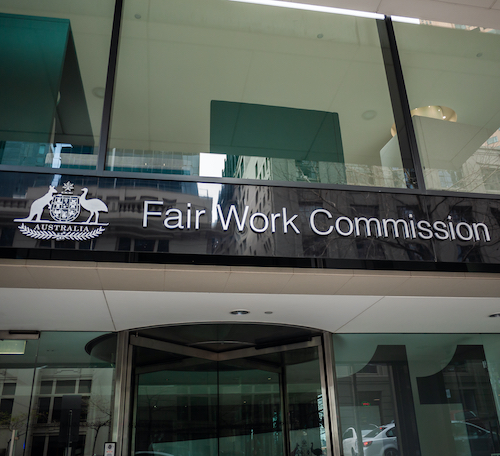
An employee's "appalling mistreatment" of a manager couldn't be "waived away" by his alleged mental health issues, the Fair Work Commission has found in unfair dismissal proceedings.
A director who could at times be "uncompromising, argumentative or abrasive" has won reinstatement, continuity of service, and $87k in backpay and compensation, after the Fair Work Commission found his dismissal for serious misconduct was unfair.
The Fair Work Commission has 'closed its eyes' to certain realities about a contracting relationship, in upholding an organisation's appeal against a finding that a delivery rider was an employee with unfair dismissal rights.
An employee who wouldn't consent to being "stabbed" with "poison" has failed to prove her employer dismissed her when it refused to send her to client sites.
It was not unfair to medically retire an employee who had been on leave for more than two years and whose mental state deteriorated "simply at the thought" of returning to work, the Fair Work Commission has accepted.
It wasn't reasonable for an employer to enforce "strict compliance" with its policies in requiring a managing director to disclose his relationship with a subordinate, a tribunal has ruled.
An employee has won the right to appeal the rejection of his unfair dismissal claim, after an informal discussion escalated into a termination meeting.
An employee's out-of-hours misconduct wasn't a "trivial instance of drunken frivolity", but rather a serious event that could have damaged an employer's reputation, the Fair Work Commission has ruled in upholding his dismissal.
An employer had a valid reason to dismiss a 64-year-old employee on restricted duties, as it wasn't "reasonable" to make further adjustments to his role, the Fair Work Commission has ruled.
All employers should consider putting in place a workplace s-xual harassment prevention plan, even though such plans are only expressly prescribed in one jurisdiction, according to a risk management expert.
Recent events have shone a spotlight on whistleblowing, placing employers firmly on notice that their response to a protected disclosure could be subject to intense scrutiny. Watch this webcast to understand the role HR plays in this challenging space.