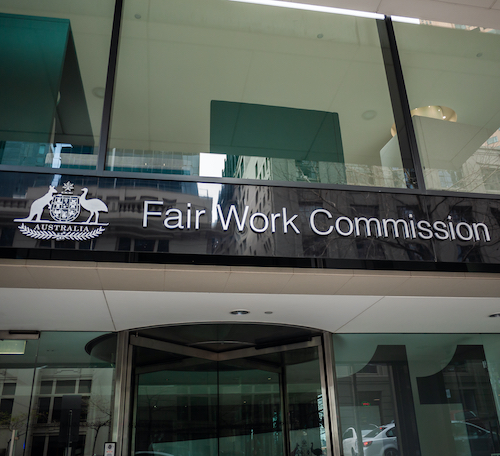
An employee has failed to convince the Fair Work Commission that he didn't deserve to be dismissed because his numerous Facebook friend requests and unsolicited messages to a young female colleague were actually from his seven-year-old son.
An employee who "intimidated" another worker into taking a "sickie" during industrial action has been awarded $65.6k in compensation after the Fair Work Commission found his dismissal was harsh.
A self-proclaimed "touchy-feely" worker has failed to prove an investigation into her alleged inappropriate workplace behaviour was "fatally" damaged by irrelevant evidence.
A stressful and demanding work environment cannot excuse inappropriate behaviour towards subordinates, a tribunal has ruled in rejecting a senior employee's disciplinary action appeal.
An employee who was sacked for accusing his employer of covering up its own negligence has lost his unfair dismissal claim, with the Fair Work Commission finding he jumped to "quick, ill-informed conclusions".
An HR manager's decision not to notify a "threatening" employee of all the reasons why he was being sacked resulted in an unfair dismissal, the Fair Work Commission has ruled.
The Federal Court has ordered the reinstatement of an employee sacked for making "deliberately provocative" social media posts, but declined to order damages for distress, finding he didn't appear to be "an individual whose feelings might easily be hurt".
An employee who won reinstatement six years ago after being sacked for misconduct has again been given his job back, with a commission finding his most recent dismissal was a disproportionate response to his "stupid" out-of-hours behaviour.
An employee has failed to argue a different standard of conduct applied during a consultative meeting, in appealing against the severity of disciplinary action imposed on him for poor behaviour.
An employee's "vile and racist" social media posts were anonymous enough not to be a sackable offence, but his "violent takedown" of another person warranted his dismissal, the Fair Work Commission has found.
All employers should consider putting in place a workplace s-xual harassment prevention plan, even though such plans are only expressly prescribed in one jurisdiction, according to a risk management expert.
Recent events have shone a spotlight on whistleblowing, placing employers firmly on notice that their response to a protected disclosure could be subject to intense scrutiny. Watch this webcast to understand the role HR plays in this challenging space.