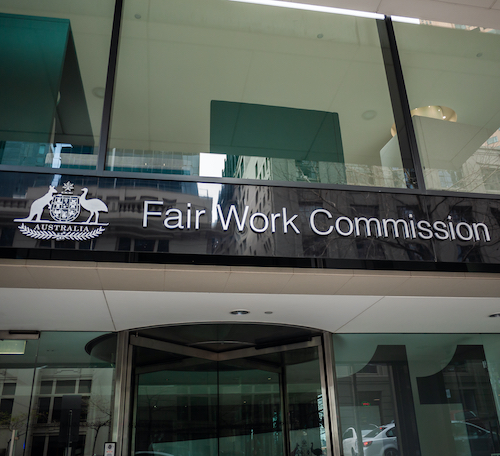
A director who became "erratic and abusive" after a workplace relationship broke down has lost his unfair dismissal claim, with the Fair Work Commission finding the employer exhausted all other avenues before making its decision.
The fact that an employee's resignation coincided with another company's job offer undermined the "multiplicity of reasons" he gave to support his constructive dismissal claim, the Fair Work Commission has ruled.
An employer's failure to investigate alleged misconduct at a client site "heavily contributed" to an employee's unfair dismissal, the Fair Work Commission has found.
The Fair Work Commission has chastised an employer for treating a long-serving manager "with disdain", but has stopped short of finding its conduct was aimed at ending his employment.
Even though a team leader's second job wasn't with a competitor, as her first employer claimed, it was nonetheless "detrimental" to her duties and justified her dismissal, the Fair Work Commission has found.
An employee did "exactly what he should have done" when a colleague threatened to fight him several times, the Fair Work Commission has found in awarding him compensation for unfair dismissal.
An HR director's decision to sack an employee, who had taken more than 2.5 years' leave in a six-year period, was likely a breach of anti-discrimination laws, a tribunal has ruled.
An employer has failed to prove it made two roles redundant because it held a "genuine belief" that COVID was negatively impacting its business, with a court finding the timing of its decision was "inexplicable".
A long-serving employee who was legally advised to "hold off" on reporting criminal charges to his employer has lost his unfair dismissal claim, with the Fair Work Commission finding his code of conduct obligations were "unambiguously" clear.
All employers should consider putting in place a workplace s-xual harassment prevention plan, even though such plans are only expressly prescribed in one jurisdiction, according to a risk management expert.
Recent events have shone a spotlight on whistleblowing, placing employers firmly on notice that their response to a protected disclosure could be subject to intense scrutiny. Watch this webcast to understand the role HR plays in this challenging space.