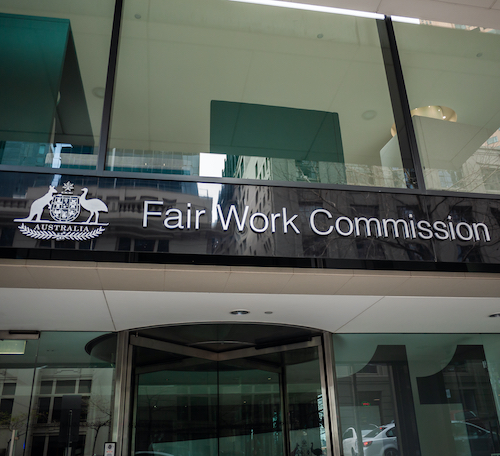
In light of the Fair Work Commission's first multi-employer bargaining decisions, many organisations will now want to think more seriously about how they can shore up control of their employment relationships, a workplace lawyer says.
An employer has claimed it didn't have to provide "gold standard" breastfeeding facilities to accommodate an employee's needs, but its pop-up tent in an open storeroom was far from an adequate solution, a tribunal found.
An employee has failed to prove that he was "performance managed out" of his job, with the Fair Work Commission finding his pattern of inappropriate conduct was a valid dismissal reason.
An employer unfairly dismissed an employee after "misunderstanding" his performance requirements and its own workplace procedures, a tribunal has found, however it declined to reinstate him due to his "manipulative" behaviour.
The FWC's first multi-employer bargaining decision reinforces that the new framework will be relevant to "pretty much every employer in the country", according to a workplace lawyer.
Three unions and 64 childcare employers have been cleared to make a multi-enterprise agreement, after a Fair Work Commission full bench found numerous factors "overwhelmingly" favoured authorising their application.
It was unfair of an employer not to inform a worker that it was reducing its casual headcount, and that rejecting a permanent conversion offer put his job at risk, the Fair Work Commission has ruled.
An employer has failed to prove it fairly sacked an employee for exposing a female colleague to explicit images, despite the Fair Work Commission accepting there was a "culture of inappropriate activity" among workers.
It was up to an employee, not his employer, to prove he acted in self-defence during a "violent" out-of-hours altercation, a Fair Work Commission full bench has ruled in overturning an unfair dismissal ruling.
A manager's "offensive" comments about an employee's weight and facial piercings were ignorant and insensitive, but didn't force her to resign, the Fair Work Commission has found.
All employers should consider putting in place a workplace s-xual harassment prevention plan, even though such plans are only expressly prescribed in one jurisdiction, according to a risk management expert.
Recent events have shone a spotlight on whistleblowing, placing employers firmly on notice that their response to a protected disclosure could be subject to intense scrutiny. Watch this webcast to understand the role HR plays in this challenging space.