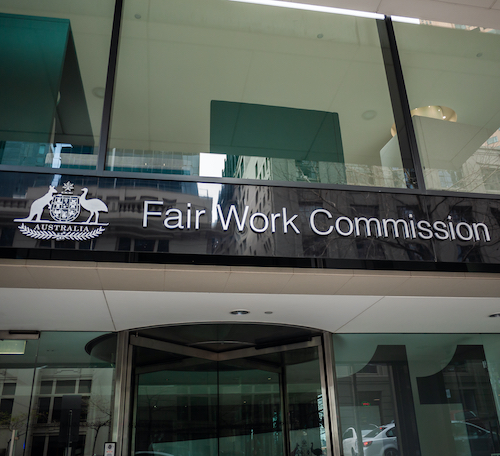
The Fair Work Commission has formally recommended an employer allow a long-serving employee to rescind his resignation and move it to a later date, enabling him to access 57 days of accrued sick leave.
An employee's lack of "insight and resilience" meant he couldn't recognise his colleagues' behaviour was a direct response to his own, the Fair Work Commission has found in stop-bullying proceedings. It also made three recommendations to ensure more "viable" ongoing relationships.
A Fair Work Commission full bench has handed down its first decision on flexible work arrangements under the new scheme, following an employer's refusal of a request for altered working hours.
An employer that failed to "advocate" for an employee when its client requested he be stood down during a serious misconduct investigation has been ordered to pay him compensation for a psychological injury.
An employer couldn't have reasonably foreseen an employee's "extraordinary" psychiatric response to his wrongful dismissal, a court has ruled in overturning his $1.44m damages award.
An employee who experienced "serious and repeated" sexual harassment at work has won an extra $129k in damages, after a court found the original $10k awarded was "inadequate in the extreme".
An employer's "outright rejection" of a trial return-to-work plan after an employee's lengthy absence was unlawful discrimination, a tribunal has ruled in awarding him more than $230k.
A director sexually harassed an employee when he slapped her on the bottom and twice declared his feelings for her, the Federal Court has found in ordering his employer to pay $268k in damages and compensation.
An employee who repeatedly provided "unacceptable" medical certificates to cover his absence effectively abandoned his employment, the Fair Work Commission has found.
An employer's dysfunction enabled an "extremely flawed" dismissal of an employee, one week after it promoted her, and it then displayed a "lack of professionalism" during unfair dismissal proceedings, the Fair Work Commission has found.
All employers should consider putting in place a workplace s-xual harassment prevention plan, even though such plans are only expressly prescribed in one jurisdiction, according to a risk management expert.
Recent events have shone a spotlight on whistleblowing, placing employers firmly on notice that their response to a protected disclosure could be subject to intense scrutiny. Watch this webcast to understand the role HR plays in this challenging space.