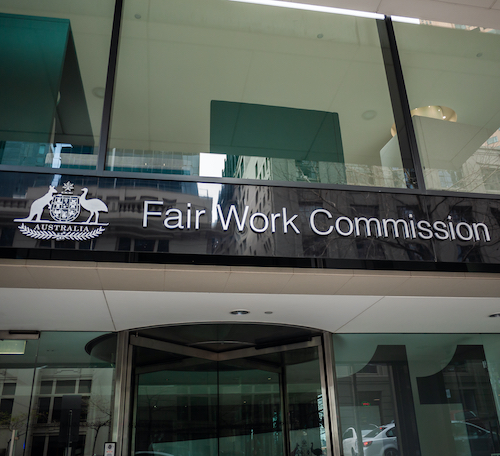
A Fair Work Commission full bench has rejected an employer's bid to overturn an unfair dismissal ruling, which ordered reinstatement against its strong objections.
A manager who responded to misconduct allegations with denials, counter-allegations, and 13 statements of support from colleagues has failed to convince the Fair Work Commission he was unfairly dismissed.
An employer victimised a complaining employee by preventing her from returning to work after a psych injury, despite her full capacity, a commission has ruled in ordering $36k in damages.
A manager's "playful gesture" to ease workplace tensions with a colleague was "entirely inappropriate", but it wasn't misconduct that warranted her demotion, a commission has ruled.
An employee's "appalling mistreatment" of a manager couldn't be "waived away" by his alleged mental health issues, the Fair Work Commission has found in unfair dismissal proceedings.
An employee held "premature" concerns that he would be dismissed if a misconduct investigation against him continued, the Federal Court has ruled in refusing to grant his request to pause it.
A worker accused of failing to read "social-emotional cues" did not harass a colleague when repeatedly trying to apologise for hitting her in the head, a commission has found.
A director who could at times be "uncompromising, argumentative or abrasive" has won reinstatement, continuity of service, and $87k in backpay and compensation, after the Fair Work Commission found his dismissal for serious misconduct was unfair.
The Fair Work Commission has 'closed its eyes' to certain realities about a contracting relationship, in upholding an organisation's appeal against a finding that a delivery rider was an employee with unfair dismissal rights.
An employee who wouldn't consent to being "stabbed" with "poison" has failed to prove her employer dismissed her when it refused to send her to client sites.
All employers should consider putting in place a workplace s-xual harassment prevention plan, even though such plans are only expressly prescribed in one jurisdiction, according to a risk management expert.
Recent events have shone a spotlight on whistleblowing, placing employers firmly on notice that their response to a protected disclosure could be subject to intense scrutiny. Watch this webcast to understand the role HR plays in this challenging space.